Two years after a period closed, a lender asks why a balance moved. Or an auditor asks who approved a reclassification. Or a client insists they never agreed to a category. The figure is in the books. The question is who decided it, when, and on what basis.
At many firms, the honest answer involves searching old email and hoping the person who made the call still works there. This post explains why approvals are so hard to prove after the fact, and how ZiePieBooks records every decision as it happens, in a log that cannot be quietly changed.
Key Takeaways:
- Most bookkeeping tools record the current state of the books, not the decisions that produced it.
- Approvals that happen in email, chat or a hallway conversation leave no reliable record.
- An audit trail only helps if it is tamper-evident. A log that can be edited proves nothing.
- In ZiePieBooks, every transaction moves through a recorded review chain, and every step is its own permanent history entry.
- Changes are written to a cryptographically chained log that is re-verified every night, and posted journals are reversed, never edited.
Why Approvals Are So Hard to Prove
Accounting software is built to answer "what is the balance?" It is much weaker at answering "who decided this, and when?" There are three reasons.
The review happens outside the system
A supervisor reviews a month by scanning a report and replying "looks good." A client approves a category in a phone call. The decision is real, but it lives in an inbox or in someone's memory. Neither survives staff turnover.
The record can be edited
Many tools let a user change a closed transaction, sometimes with a note, sometimes silently. Even when there is a change history, it is often stored in a way that an administrator could alter. A log that can be edited is a story, not evidence.
Corrections overwrite the mistake
When a journal entry is wrong and someone edits it, the original disappears. The books are now correct, but nobody can see that they were ever wrong, or what the reports said in the meantime.
What "Provable" Actually Requires
- Every approval is recorded in the system, by the person who made it, at the time they made it.
- The record cannot be quietly changed. Any tampering must be detectable.
- Corrections are additive. A mistake is reversed, not erased, so the history stays complete.
How ZiePieBooks Solves It
A recorded review chain for every transaction
In ZiePieBooks, a period's transactions move through the review chain your workflow defines: supervisor, then customer, then accountant. Each reviewer can approve or suggest a change. The customer can also reject, recategorize, or propose an account that does not exist yet. The bookkeeper resolves what comes back, and every step is on the record.
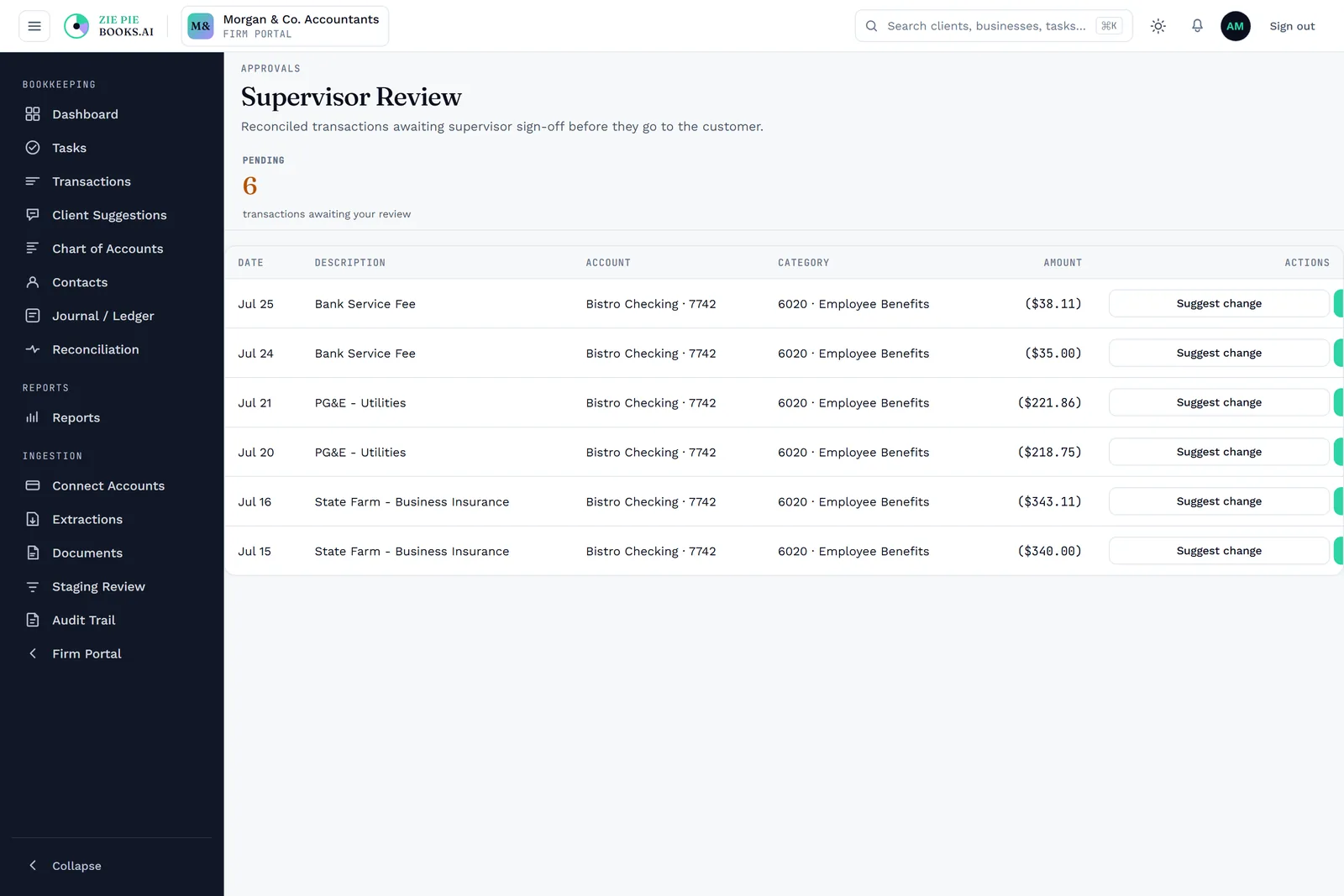
The screenshot shows why the chain matters. Utility bills and a business insurance premium have been coded to Employee Benefits. A supervisor scanning a report might miss that. Here, each line sits in front of the reviewer with a Suggest change action, and the correction becomes part of the record rather than a silent fix.
Journals with their own approval path
Manual journals, such as accruals, depreciation and reclassifications, follow their own approval path to the ledger. Each entry moves from created, through supervisor approval and customer approval, to posted. Once posted, it is reversed rather than edited.
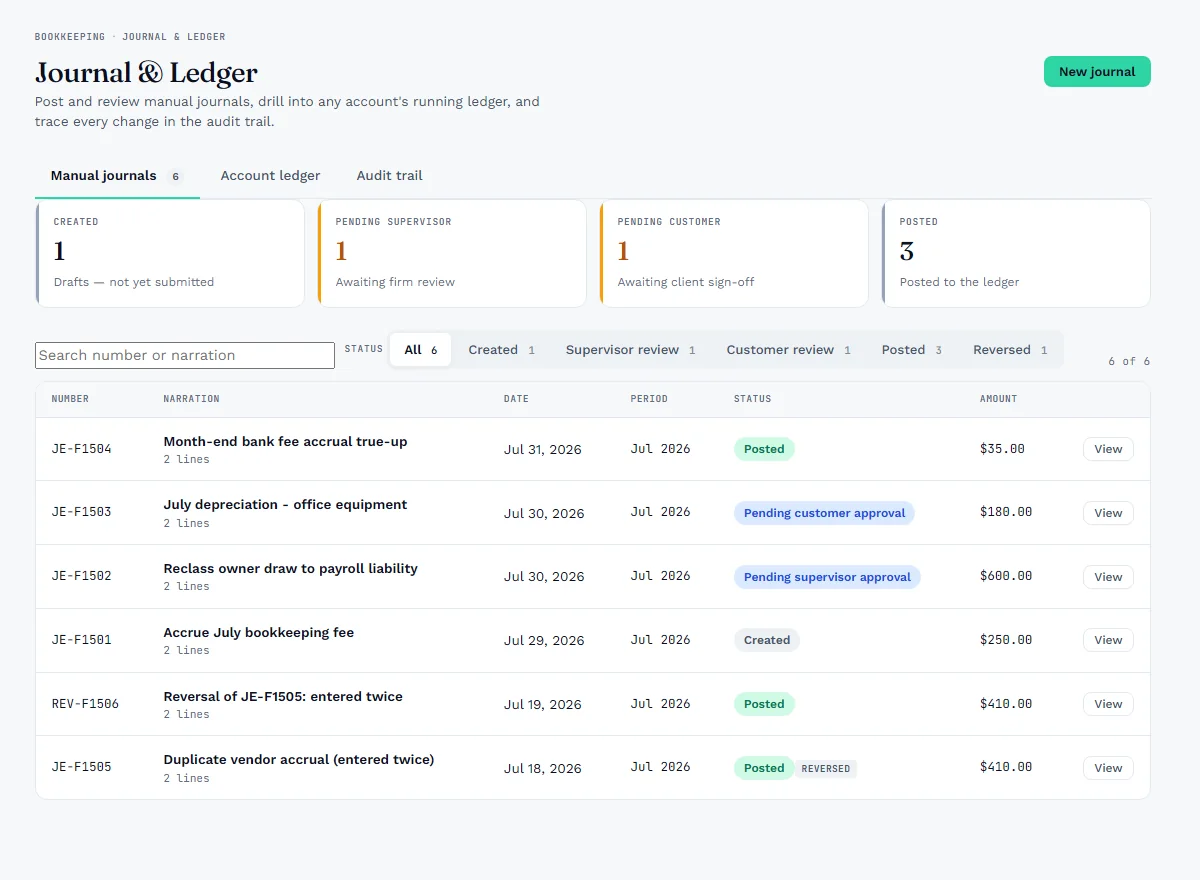
Notice the last two rows. A vendor accrual was entered twice. Instead of deleting the duplicate, the firm posted a reversal that names the original. Two years from now, anyone can see exactly what happened and when it was corrected.
A tamper-evident audit trail, verified nightly
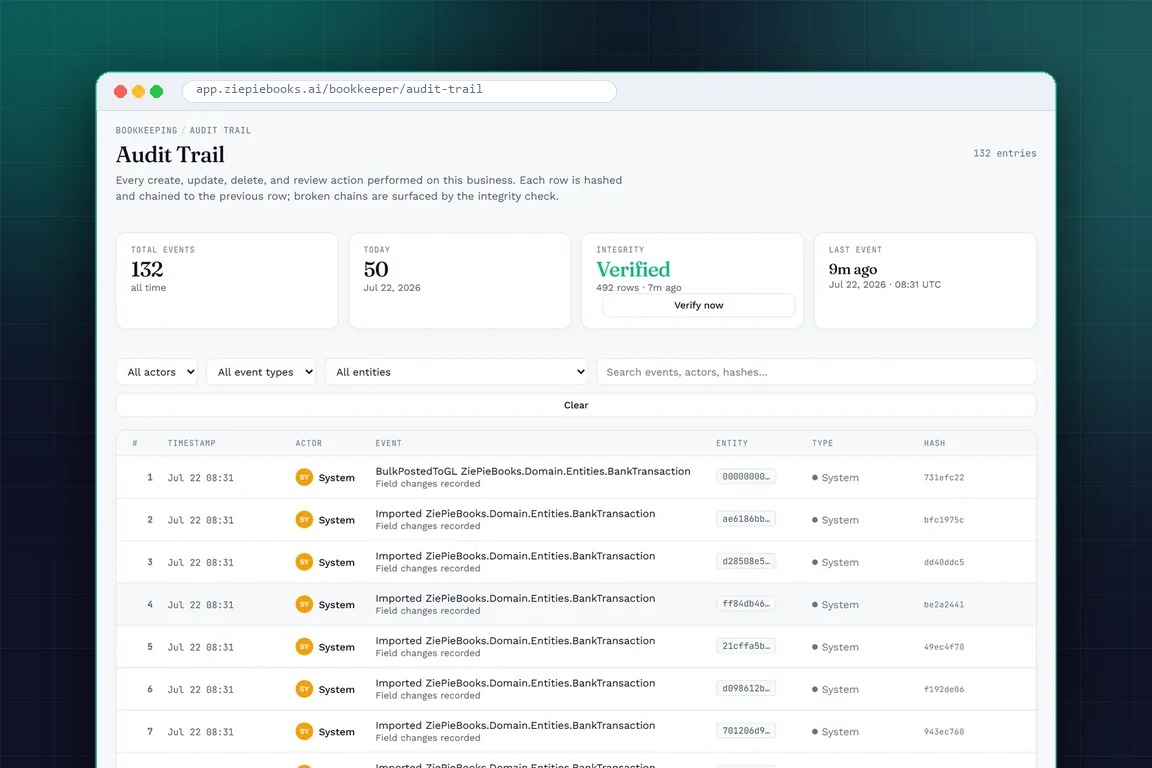
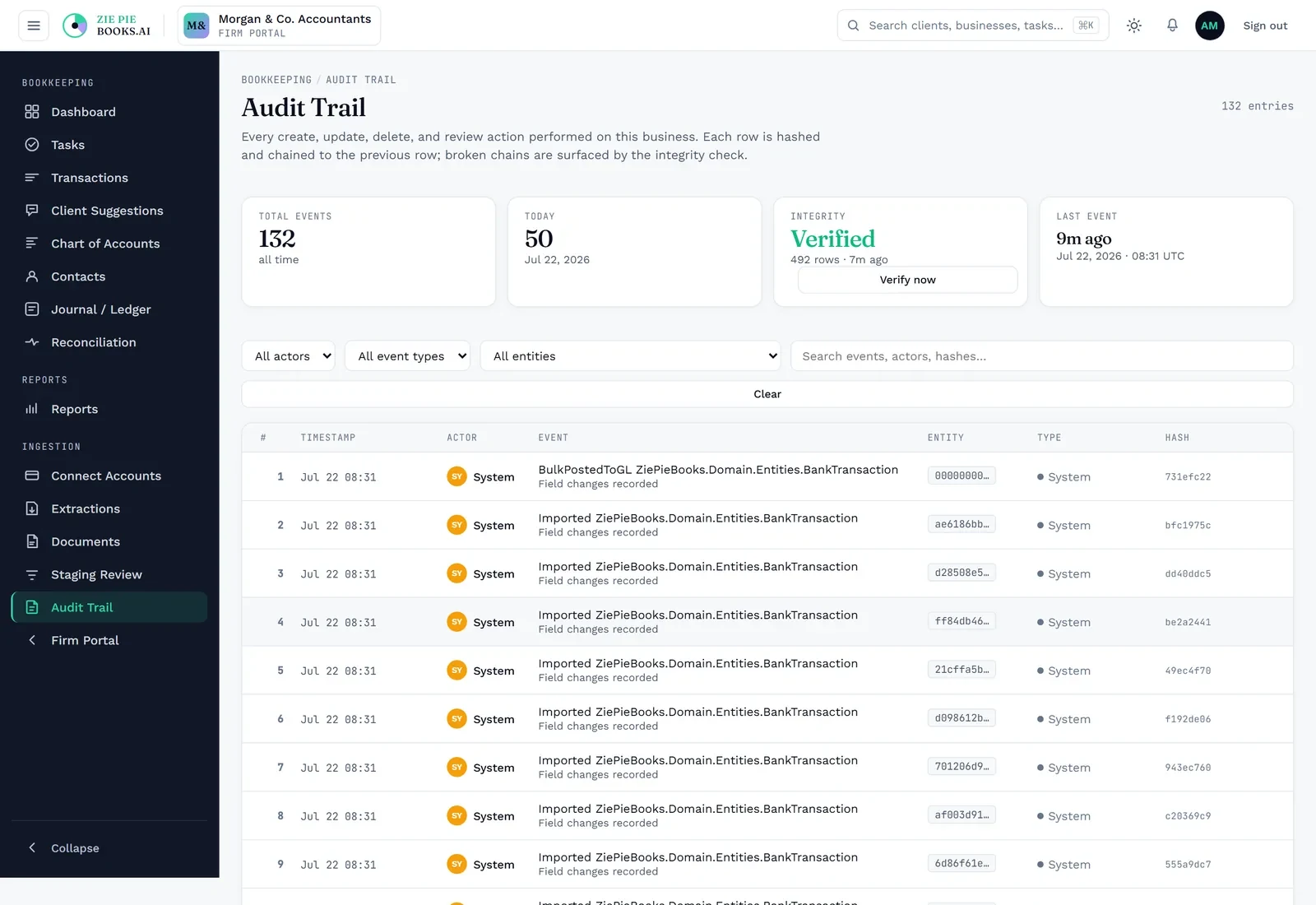
Underneath it all is the audit trail. Every create, update, delete and review action on a business is recorded. Each row is hashed and chained to the previous row. If someone altered a closed record, the chain would no longer line up, and the integrity check would surface the break. The chain is re-verified every night, and you can run the check on demand.
Answering the Two-Years-Later Question
With those pieces in place, the lender's or auditor's question becomes a lookup:
- Open the account's ledger. Every line links to the entry behind it, from opening balance to closing.
- Open the entry. See its approval history: who created it, who approved it at each stage, and when.
- Check the period. See who locked it, when, and whether it was ever reopened.
- Check the client sign-off. See the name they typed, the date, and where it was signed from.
- Point to the integrity check. Show that the history has not been altered since.
Make every approval provable
The review chain, journal approvals and hash-chained audit trail are included on every ZiePieBooks plan. Start with a 30-day free trial. Create your free account or read how we handle security.
Frequently Asked Questions
What is a hash-chained audit trail?
+
Each entry in the log is hashed together with the entry before it. If anyone altered or removed an earlier record, the chain would no longer line up, and an integrity check would surface the break.
How often does ZiePieBooks check the audit trail?
+
The chain is re-verified every night, and the Audit Trail screen also lets you run the integrity check on demand and shows when it last passed.
Can a posted journal entry be edited in ZiePieBooks?
+
No. Once posted, a journal entry is reversed rather than edited. The original, the reversal and the corrected entry all remain on the record with their own approval history.